 Experiences
Are food tours worth it? How to choose a good one
When a food tour earns its price, when to skip it and walk the market yourself, and a checklist for reading a tour listing before you book one.
The short versionA food tour is worth it on your first day in a city whose food or language you don’t know, if it keeps the group small, adds up to a proper meal and has a guide who knows the food. Skip it when you can already read the menu, when the stops are shops handing out samples, or when a morning at the market with a list would show you the same for the price of what you eat.
A food tour is worth it when it does what you can’t easily do alone. On your first day in a city whose dishes, menus or language you don’t know, a small group with a guide who knows the food, eating proper tastings that add up to lunch, teaches you what to order for the rest of the trip. It isn’t worth it when you already know the cuisine, when most of the stops are shops handing out samples, or when a morning at the market with a list would show you the same for the price of what you eat. Before you book, read the listing for the group size, how many stops are real tastings, the drinks, the time of day, dietary needs, who the guide is and the cancellation terms. The checklist below runs through them in order.
When a food tour is worth it
A tour earns its price when it saves you days of working things out:
- Your first day. You learn the dishes and how to order them while there is still a trip left to use them in.
- A cuisine you don’t know. The guide names what is on the plate, what it is called on menus and when it is in season.
- A language or a script you can’t read. Menus with no translation, counters where people order by pointing, stalls where nothing is labelled.
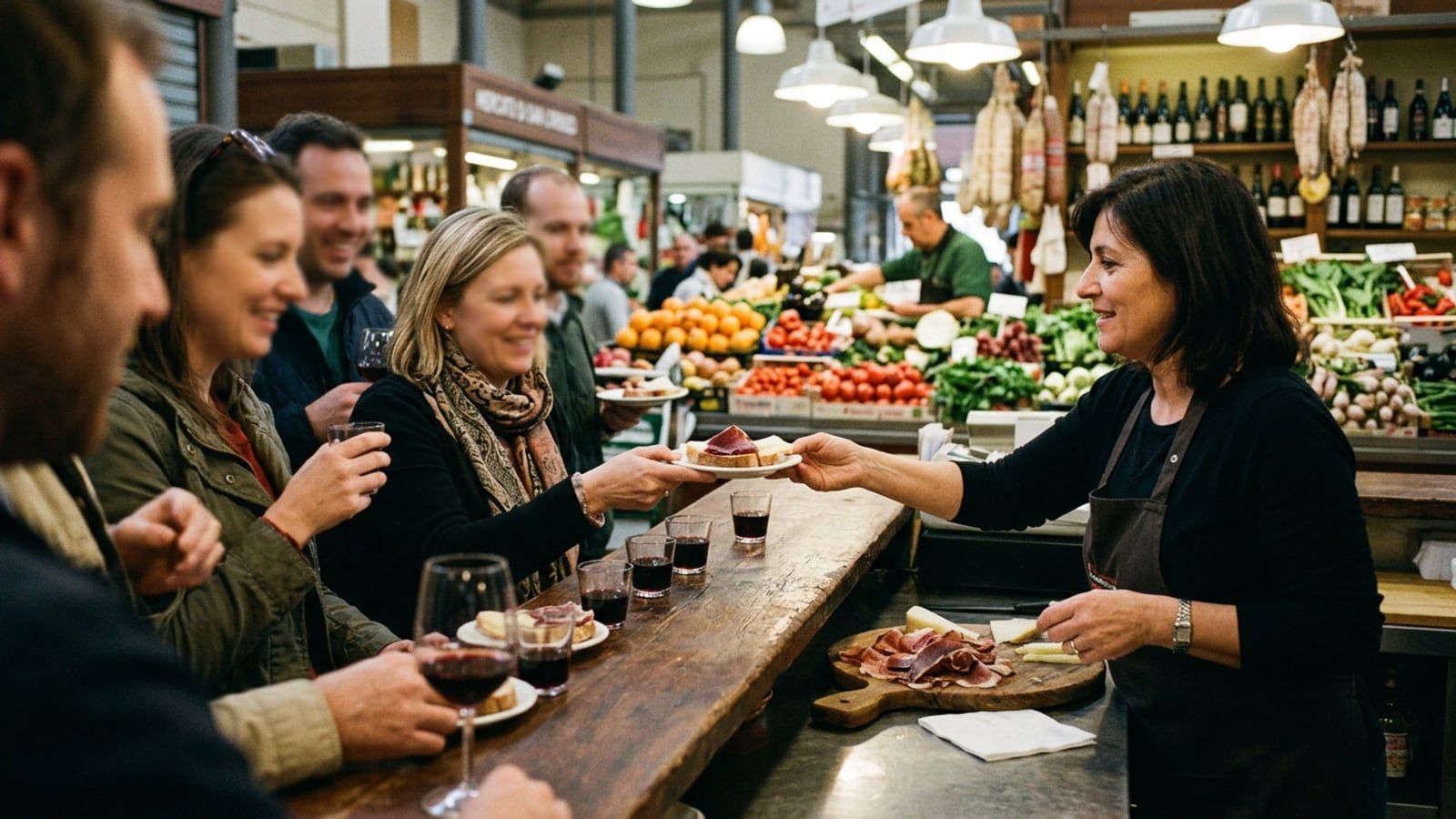
- A market morning. The guide talks to the stallholders, shows you what to buy and what to eat on the spot, and where the market’s own counters are.
- Travelling alone. A single diner can’t order six plates to share; a tour puts them in front of you, with company at the table.
- One free afternoon. Several neighbourhood places in a few hours, with the walking between them planned.
When to skip it
- You already know the food. If you can read the menu and know what to order, a tour is an expensive lunch.
- The stops are shops. A listing full of samples at an olive oil shop, a cheese counter and a liqueur shop reads like a shopping trip, and may be one.
- The group is big. A group that can’t fit round one counter or a couple of tables spends the tour queueing. A listing that won’t say how many people go is a warning.
- It takes the place of a meal you have booked. A tour is lunch. Put it on a day without a big booking, not before one.
- The sums don’t work. Add up what the dishes listed would cost you at the same places on your own. If the tour costs much more and adds little but the walking, walk.
- Your diet isn’t covered. If the listing says nothing about vegetarian food or allergies and the operator can’t answer clearly, the tour will feed everyone but you.
Book it for your first day
A tour pays back most on the first full day, when everything it teaches is still useful: the names of the dishes, how the counter works, what the menu of the day is, which market hall is worth a morning, and a few places to go back to on your own. On the last day it is just lunch.
Plan it as a meal, because it is one. In our method for planning a food trip, the tour stands in for lunch on the first day and stays off any day with a booked anchor meal. Choose the time of day for the food you want: a morning or lunchtime tour sees the markets and bakeries open, an evening tour the bars and small plates. Markets keep their own days, so check that the market on a tour is open on the day you book it.
Read the listing: a checklist
Run through this on the listing page before you pay:
- Group size. A stated maximum, and whether your booking can be combined with another group.
- Stops. How many, and how many are proper tastings (a dish or a plate) rather than a sample at a shop counter.
- A meal or a snack. Whether the food adds up to lunch or dinner, in so many words.
- Drinks. Which are included (wine, beer, coffee, water), how many, and what there is if you don’t drink alcohol.
- Time and length. When it starts and how long it runs, and whether that fits the markets’ hours and your other meals.
- Walking. How far, how hilly, and whether there are steps; important in a city of hills and cobbles, and for anyone who needs step-free access.
- Dietary needs. Whether it can cater for vegetarians, vegans, coeliacs and allergies, and how you tell them.
- The guide. A named guide or company, what they know about the food, how long they have guided, the language of the tour, and a badge or licence where the country has one.
- Where it ends. The meeting point and the finishing point, which may be across town from your hotel or your dinner.
- What isn’t included. Tips, transport, extra drinks.
- Cancellation terms. The deadline for a full refund, and what happens in bad weather or if the operator cancels.
- Reviews. Recent ones that talk about the food and the stops, not only the guide’s jokes.
On badges: some places accredit or license guides. In England, for example, the Institute of Tourist Guiding awards the Blue Badge for guiding round a region or city, the Green Badge for a town or defined area and the White Badge for a single site, as its qualifications page sets out. A badge shows a guide has qualified in guiding, not that they know where to eat, so count it as a plus and judge the stops on their own.
Questions to ask before you book
If the listing leaves gaps, email the operator before you book. A good one answers quickly and specifically, and a vague reply tells you something too.
- How many people go at most?
- Which stops, and are they the same every day? What happens when one is closed for a holiday or a market day?
- Is there enough food to count as lunch (or dinner)?
- Can you cater for my need (name it) at every stop, and what will I eat where you can’t?
- Does any stop pay to be on the tour, or sell to the group?
- Who will guide it, and in what language?
- What happens if it rains?
Through a booking platform or the operator
Many tours are sold both ways: on a booking platform and on the operator’s own website. Read the terms on whichever page you pay through.
| What to compare | Booking platform | The operator, direct |
|---|---|---|
| Cancellation | The platform’s terms for that listing, shown before you pay | The operator’s own terms, which vary |
| Reviews | Many tours compared in one place | On the operator’s site and on review sites |
| Who you deal with | The platform until the day, then the operator | The people who run the tour, throughout |
| Where the money goes | The platform takes a commission from the operator | All of it to the operator |
| If something goes wrong | The platform’s customer service as well as the operator | The operator |
On cancellation, the terms are set listing by listing. Viator’s documentation for the operators it sells gives its standard policy as a full refund if you cancel at least 24 hours before the start time, and marks some experiences “All Sales Final”, which can’t be refunded. Other platforms and operators set their own, so check the terms on the listing itself before you pay, and keep a copy.
Check whether the guide’s tip is included, too. Where it isn’t, our guide to tipping in Europe goes country by country, and covers guides too.
A cooking class or a market walk instead
A tour isn’t the only way to learn a city’s food.
- A cooking class. You shop, cook and eat a meal, and come home with a dish you can make again. It suits a rainy day, a second visit to a city, or a cuisine you want to cook rather than only eat.
- A market walk on your own. Go in the morning, when the stalls are full. Walk the whole market once before you buy, buy small amounts, eat at the market’s own counters, and ask the stallholders what is in season. Take a list of the dishes you want to try, so you know what to look for.
A guide does that list for you, city by city. Our guide to where to eat in Lisbon goes neighbourhood by neighbourhood, from breakfast to the last drink, and City Tables plans each lunch of a trip: the menu of the day at a neighbourhood restaurant, the market hall, or the long lunch worth giving the afternoon to. For more tours, classes and things to do between meals, see Experiences.
Questions
How long does a food tour usually last?
Most walking food tours are planned round a single meal, so they take a morning, a long lunch or an evening rather than a whole day. The listing gives the length and the number of stops, so divide one by the other to see how long you will have at each. Plan nothing big to eat straight afterwards.
Is a food tour enough for lunch?
A good one is, and its listing says so, in words such as ‘replaces lunch’ or ‘come hungry’. If it talks about samples or tastings without saying how much food there is, ask the operator, or eat something first. Don’t book a tour and a lunch on the same day.
Can food tours cater for vegetarians and allergies?
Many can, if you tell them when you book rather than on the day, because the stops are arranged in advance. Name the need exactly (vegetarian, vegan, coeliac, a nut allergy) and ask what you will eat at the stops that can’t adapt. For a serious allergy, ask whether every stop can tell you what is in each dish, since market stalls and bars often share counters and fryers.
Should you tip a food tour guide?
Read the listing first: some include the guide’s tip, and many say it is not included. Customs differ from country to country, so check the one you are in; where tipping a guide is usual, give it in cash to the guide at the end. Our guide to tipping in Europe covers guides, hotels and taxis as well as restaurants.
Sources
- Cancellation policies and processes, Viator
- Our qualifications, Institute of Tourist Guiding