 Eat & Drink
Tipping in Europe: a country-by-country guide to the bill
Whether service is already on the bill in 20 European countries, what to add if it isn’t, and how to tip by card or in cash, with a source for every row.

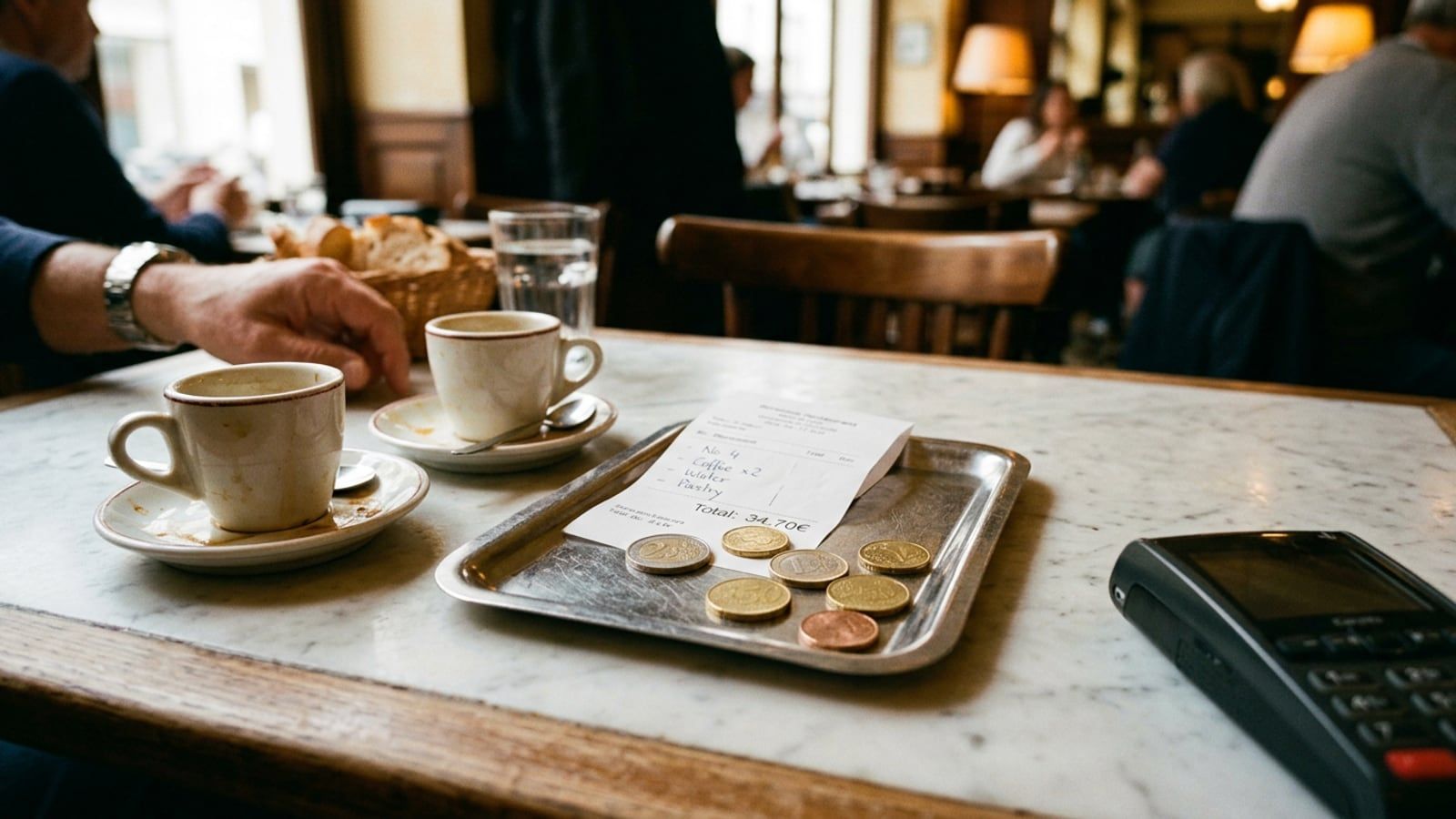
The short versionRead the bill first: in much of Europe service is already in the price, and a cover charge such as the Portuguese couvert or the Italian coperto is not a tip. Where service is not included, rounding up or adding 5 to 10% for good table service covers most countries, and a tip in cash is the surest way for it to reach the person who served you.
Read the bill before you reach for your wallet. In much of Europe service is already in the price, and a line at the bottom that looks like a charge for the waiter may be a cover charge for sitting down: the couvert in Portugal, the coperto in Italy. Where service isn’t included, rounding up or adding 5 to 10% for good table service is the custom in most countries, a coffee at the counter needs nothing, and a tip in cash is the surest way for it to reach the person who served you. The table below gives each country’s custom with the sources it rests on, and says where those sources disagree. These are customs, not rules: nobody can make you tip.
The short answer: read the bill first
At the end of any meal in Europe, run through the same five checks before you add anything:
- Find the service line. Look at the bottom of the bill or the menu for service compris in France, servizio in Italy, szervizdíj in Hungary or “service charge” in Ireland. If service is already there, a tip on top is a bonus, not a duty.
- Separate the cover charge. A couvert or coperto is a charge per person for the table, the bread or both. It is not a tip, and paying it doesn’t settle one.
- Check what you were brought. Bread, olives or small starters put on the table before you ordered may be on the bill. Send them back when they arrive if you don’t want them.
- Use the country’s custom. If nothing is included, the table below gives the usual amount.
- Decide how to pay it. Cash in the server’s hand, or the total said aloud before the card machine is keyed in.
Service charges, cover charges and the couvert
Service reaches the bill in two ways. In some countries it is included as a matter of course, usually in the menu prices, so the bill shows nothing extra for it: France, Belgium, Denmark, Finland, Switzerland and the Netherlands are among them. In others a restaurant may add a line for it, usually a percentage, and in Hungary, Italy, Ireland and now some Norwegian restaurants that line turns up often enough to look for.
A cover charge is something else. In Portugal, Wikivoyage warns that being charged for the couvert is very common even when you didn’t ask for it, and that the price on the menu is per person: refuse the bread and olives when they arrive, or accept them and pay. DECO PROteste, Portugal’s consumer association, says nothing you didn’t ask for and didn’t touch can be charged, the couvert included, but that once you eat it you pay. Our Lisbon food guide explains what lands on the table there and how the bill works.
In Italy, Wikivoyage’s guide to Italy says restaurants often charge a coperto, usually €1 to €3 per person, which is separate from tipping. Wikivoyage’s Spain guide adds that bread (pan), cheese and other appetisers may be brought to your table unasked and still charged, so say so politely if you don’t want them.
Country by country
The table covers the countries UK travellers visit most. Each row rests on the sources named in its last column, among them the official tourism sites, Which?’s guide to tipping abroad and Wikivoyage’s country guides, a cross-check for most rows and the main source for Portugal’s and Croatia’s. “Not stated” means none of those sources says either way.
| Country | Service included? | Restaurants | Cafés and bars | Watch for | Sources |
|---|---|---|---|---|---|
| France | Yes, in the price | Optional: not expected (Wikivoyage); 10–12.5% more for good service (Which?) | Not customary in bars | Service compris on the menu or bill | Which?; Wikivoyage |
| Spain | Nothing is added (see below) | Nothing at simple places; 5–10% at smarter ones | Round up or leave the change | Pan: bread you didn’t order may be charged | Spain.info; Which?; Wikivoyage |
| Portugal | Not stated | 8–10% for exemplary service; nothing is fine otherwise | Nothing for a coffee, a cake or a drink | The couvert, priced per person | Wikivoyage; DECO PROteste |
| Italy | Often a cover charge; sometimes service | Nothing on top of service, otherwise round up to the next €5 or €10 (Which?); close to 10% (Italia.it) | Leave the change; €1–2 in tourist cities | Coperto and servizio | Which?; Italia.it; Wikivoyage |
| Greece | Sources differ | Round up in tavernas; 5–15% in restaurants | Not expected in bars | Hand the cash to the waiter | Which?; This is Athens; Wikivoyage |
| Germany | No | 5–10%; 10% somewhere smart with good service | Round up in cafés; a few coins in the jar at a bar | Say the total as you pay | Berlin.de; Wikivoyage |
| Austria | Sometimes: check first | 5–10% | Around 10% in coffee houses | Say the total as you pay | Vienna Tourist Board; Wikivoyage |
| Switzerland | Yes, in the price | Not obliged; round up, or about 10% | Round a coffee up to the franc | — | MySwitzerland; Wikivoyage |
| Netherlands | Yes, in the price | 5–10% for good service | Not stated | A tip prompt on the card machine | Holland.com; Wikivoyage |
| Belgium | Yes, always | 5–10% is acceptable, never required | As in restaurants | — | visit.brussels; Wikivoyage |
| Ireland | Sometimes; a compulsory one must be made clear in advance | About 10% for good service, up to 20% | Nothing for drinks at the bar | “Service charge”, and whether it is optional | Visit Dublin; CCPC; Wikivoyage |
| Denmark | Yes | Optional, for great service; no set amount | Optional | — | VisitDenmark; Wikivoyage |
| Norway | More restaurants now add one | Optional: 5–15% | Usual when you’re happy with the service | A service line, then a tip screen | Visit Norway; The Local |
| Sweden | Sometimes, and the bill says so | Round up; 10% if you want to give more | Not stated | A service charge stated on the bill | Visit Sweden; Wikivoyage |
| Finland | Yes, always | Optional, never expected | Optional | The tippikello, a tip bell on some bar counters | Visit Finland; Wikivoyage |
| Iceland | Not stated | Not expected | Not expected | A cash tip for exceptional service is welcome | Visit Reykjavík; Wikivoyage |
| Czechia | Not normally added | Round up; about 10% in tourist restaurants | Round up by a few crowns | The VAT line is tax, not service | Visit Czechia; Wikivoyage |
| Croatia | No, says Wikivoyage | 5–10%, rounding up; more than 10% is unusual | Round up, or leave a coin | Carry small notes to tip in cash | Wikivoyage |
| Hungary | Sometimes, 10–15% | About 10% if none is added | About 10% | Szervizdíj, the service charge | Visit Hungary; Budapest Info; Wikivoyage |
| Poland | Not stated | 5–15% in popular cities; around 10% | Not expected in bars | “Thank you” as you hand over cash means keep the change | Which?; Wikivoyage |
Where the sources disagree
- France. Wikivoyage says a tip is neither compulsory nor expected, since the staff are paid a full wage; Which? suggests adding a further 10 to 12.5% for good service on top of the service compris.
- Spain. Spain.info says every establishment includes the service charge; Wikivoyage says no service charge is included in the bill. At the table they come to the same thing: nothing is added for service, and a tip is your choice.
- Italy. Which? says there is no need to tip on top of a cover or service charge; Italia.it, the official tourism site, says leaving close to 10% is customary when you are happy with the service.
- Greece. Which? describes service charges already included in standard restaurants; This is Athens, the city’s visitor guide, says there is no service charge in bars and restaurants.
- Belgium. visit.brussels calls a 5 to 10% tip customary; Wikivoyage says tipping isn’t usually done, since service is always included.
- Iceland. Visit Reykjavík welcomes a cash tip for exceptional service; Wikivoyage warns that, rarely, a tip may be taken as an insult.
Where the amounts differ, the table gives both.
Cafés, bars and the counter
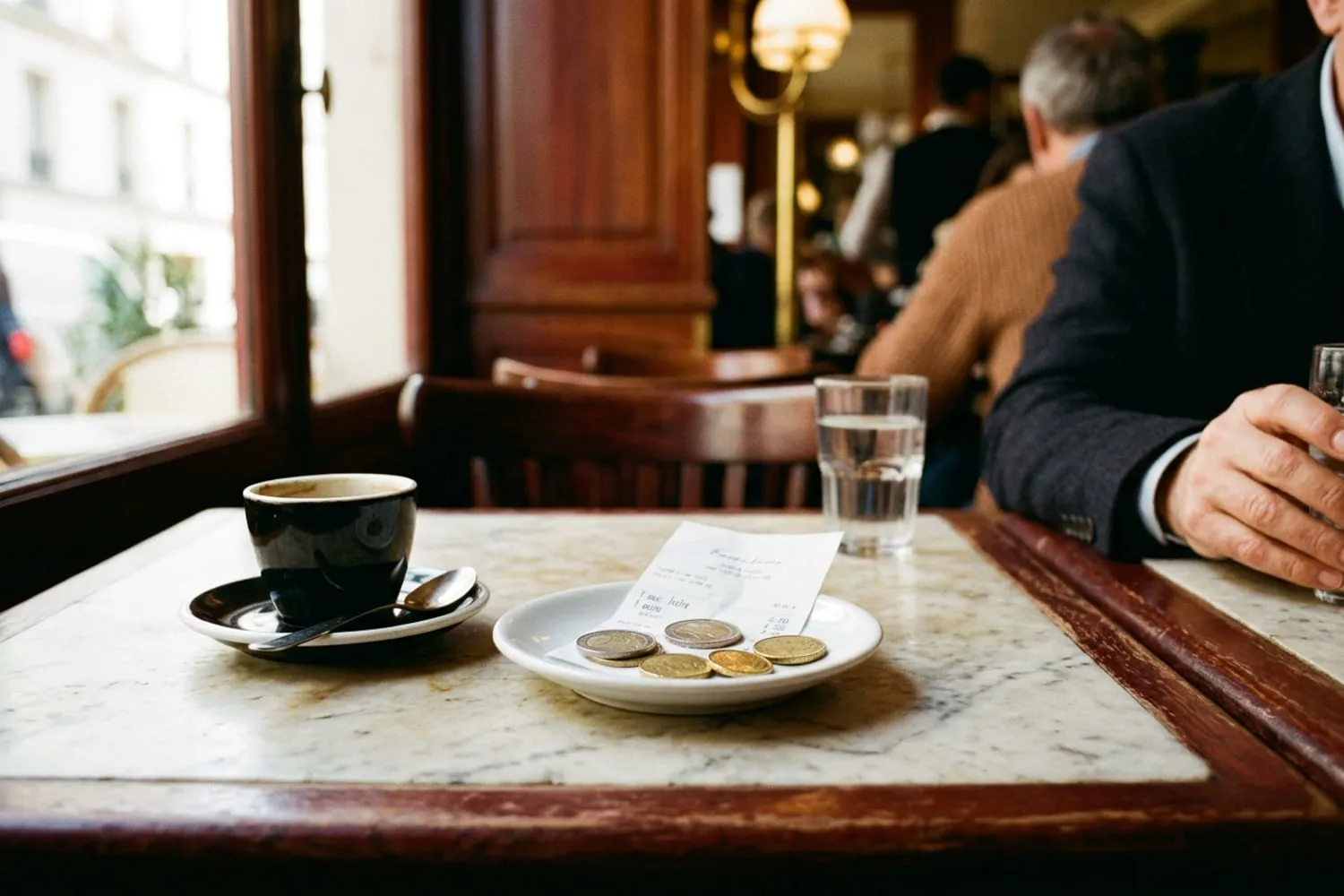
A coffee drunk standing at the counter rarely needs anything. In Portugal, Wikivoyage says not to tip for a coffee, tea, a cake or a sandwich; in Italy it is common to leave the change at a café or bar, saying tenga il resto (“keep the change”); in Czechia people round up by a few crowns, and in Switzerland a coffee is rounded up to the franc.
Bars follow the same pattern. Which? says tipping isn’t customary in French bars and isn’t expected in Greek or Polish ones, and Visit Dublin says you don’t need to tip when buying drinks in an Irish pub. In Germany a few coins in the jar is enough at a casual bar, according to Berlin’s official site, and in Spain people round up or leave the change. Norway is the exception: Visit Norway says tipping is uncommon there except in bars and restaurants.
If the evening ends at a kiosk or a terrace, the same small change does the job. For where to have that drink in each neighbourhood, City Tables plans the last drink a short walk from dinner.
Tipping by card or in cash
Cash is the surer way for a tip to reach the person who served you. Which? warns that a tip added by card may never reach the staff, Berlin’s official site says to give it in cash if you can, and Visit Hungary says staff prefer a cash tip even when you pay the bill by card.
In Germany and Austria you don’t leave money on the table: you hand over the payment and say the total you want to pay, tip included. Berlin.de’s example: for a €15.90 bill, hand over a €20 note and say “18”. In Poland, Wikivoyage warns that handing over cash and saying “thank you” means you’re leaving the change as a tip, so wait for it if you want it back.
To add a tip on a card machine:
- Check the bill for a service line first, so you don’t tip twice.
- Say the total you want to pay before the server keys the amount into the machine.
- If the terminal shows a tip screen, choose a percentage, enter your own amount or skip it. In the Netherlands, Holland.com says the machine sometimes asks whether and how much you want to tip.
- If it asks whether to pay in pounds or the local currency, that is a separate question about the exchange rate, covered in our guide to paying in local currency or pounds abroad.
- Read the amount on the screen before you tap or enter your PIN.
Some places can’t take a tip by card at all. Wikivoyage says a tip can’t be added by hand to a card payment in Italy, and in Croatia it suggests carrying some small notes to tip in cash, since it doubts a tip by card reaches the person who served you.
Tip: Keep a few one- and two-euro coins, or the local equivalent, in a pocket apart from your wallet. Rounding up a coffee or leaving the change at a bar is easier with coins to hand than with a card machine.
Hotels, taxis and guides
The amounts here are smaller, and mostly about rounding.
- Hotel porters: €1–2 a bag is expected or usual in France, Spain, Greece and Italy, according to Which?, and Berlin’s site gives the same for Berlin. In Poland, Which? says a tip is only needed in five-star hotels: 5–10 złoty per bag or per day.
- Housekeeping: €1–2 in Spain, and €1–2 a day in Greece and Italy (Which?); €2–3 a day in Berlin (Berlin.de).
- Taxis: round up to the nearest euro in France and Italy, give 10% in Spain if you wish, and round up or add 5–10% for longer trips in Greece (Which?). In Poland, round up to the nearest 5 or 10 złoty. In Denmark the tip is already in the fare, says VisitDenmark, and in Sweden Wikivoyage says taxi drivers don’t expect one.
- Tour guides: €2–5 per person per day in France, plus €1–2 per person per day for the coach driver; €2–5 per person for a group tour in Greece; €5–15 in Spain; €5–10 in Italy; 10% for a private guide in Poland, where government guides at historical sites don’t expect a tip (all Which?). Walking tours advertised as “free” are the one place in Sweden where Wikivoyage says a tip is expected, since the guide works for it.
When a tip is already on the bill
If service is on the bill, you don’t have to add more, and you shouldn’t pay it twice. The Vienna Tourist Board says it plainly: look at the bill, and if the tip is already included, don’t pay it again. Which? gives the same advice for card machines: don’t add a second tip on the terminal.
A few things to watch for:
- A tip screen after a service charge. The terminal may ask for a tip whatever the bill says. Choose no tip or enter zero. Ireland’s consumer watchdog, the CCPC, tells businesses that tipping on a payment terminal should be easy to avoid.
- “Tip not included” in English. Wikivoyage’s Spain guide notes that some bills carry a line in English saying a tip isn’t included. It is a reminder, not a charge, and tipping in Spain stays optional.
- A service charge on the menu. In Hungary, the city’s Budapest Info service advises checking the menu and drinks list for service fees before you order, since that is where they are usually shown.
- An addition you didn’t expect. Wikivoyage’s France guide says nothing should be added to the advertised price there, and not to hesitate to question it. The same goes anywhere: ask what a line is before you pay it.
For more on eating out abroad, from booking a table to what to order, see our Eat & Drink section.
Questions
Is service included in restaurant bills in Europe?
Often it is. The official tourism sites for Brussels, Denmark, Finland and Spain say service is included, and in France, Switzerland and the Netherlands it is built into the menu price. Berlin’s official site says it usually isn’t included there, Wikivoyage says the same of Croatia, and in Hungary, Italy, Austria, Ireland and Sweden a service line sometimes appears, so read the bill before you add anything.
Do you tip in Portugal?
A tip isn’t expected. Wikivoyage suggests around 8 to 10% when the service was exemplary, says it is perfectly acceptable not to tip otherwise, and says nothing is expected for a coffee, a cake or a drink at a bar. The couvert, the bread and olives put on the table before you order, is a separate charge, not a tip: Portugal’s consumer association, DECO PROteste, says it can’t be charged if you didn’t ask for it and didn’t touch it.
What is the coperto on an Italian bill?
The coperto is a cover charge per person for sitting down to eat, usually €1 to €3 according to Wikivoyage. It is separate from a tip. When a cover charge or a service charge is already on the bill, Which? says there is no need to tip on top; leave a little more only for service you want to reward.
Should you tip by card or in cash in Europe?
Cash is the surer way: Which? warns that a tip added by card may never reach the staff, and Berlin’s official site and Visit Hungary both suggest cash. Where you do tip by card, say the total you want to pay before the server keys it into the machine, or use the tip screen if the terminal shows one. In Italy, Wikivoyage says a tip can’t be added to a card payment by hand, so keep some coins.
Do you tip at the bar in Europe?
Mostly not. Which? says it isn’t customary in French bars or expected in Greek or Polish ones, and Visit Dublin says you don’t tip for drinks in an Irish pub. Rounding up or leaving the change is common in Spain, Italy and Germany, and Norway is the exception, where Visit Norway says people tip in bars as well as restaurants when they are happy with the service.
Sources
- Guide to tipping abroad: how much to tip on your summer holiday in 2026, Which?,
- Tipping etiquette, Berlin.de
- Currency in Spain: where to exchange money and how to pay, Spain.info
- Italy travel guide: Tipping and Eat, Wikivoyage
- France travel guide: Eat, Wikivoyage
- Portugal travel guide: Tipping and cover charge, Wikivoyage
- Restaurantes: regras para a cobrança de entradas, gelo e copos de água, DECO PROteste,
- Croatia travel guide: Tipping, Wikivoyage
- Tipping in Sweden, Visit Sweden
- Currency and prices, Visit Norway