 Where to Stay
Is it cheaper to book a hotel direct? How to check
Sometimes. A ten-minute check for one stay: the same room and terms on both, an email to the hotel, breakfast counted, and when a booking site still wins.

The short versionSometimes, and the only way to know is to check your own stay: price the same room, board and cancellation terms on a booking site and on the hotel’s own website, then email the hotel for its direct price. Book whichever is cheaper on the same terms, counting breakfast, the city tax and what you would lose if the trip moved.
Sometimes, and you can find out for your own stay in about ten minutes. Price the same room, with the same breakfast and the same cancellation terms, on a booking site and on the hotel’s own website. Then email the hotel and ask for its direct price. Book whichever comes out cheaper on the same terms, and count the breakfast, the city tax and what you would lose if the trip moved.
No rule holds for every hotel. When Which? priced 30 overnight stays in ten hotels across nine websites, it found that booking direct was cheapest half the time, and that Agoda, Expedia and Booking.com each had the dearest price on 13 or 14 of the 30. Its advice: narrow the choice on comparison sites, then book with the hotel. The other half is why you check.
Compare like with like
A booking site’s cheapest price and a hotel’s cheapest price are often for different things. Before you compare the numbers, make them the same stay:
- The same room. Match the room type and the bed, not just the word “double”. Check the size or the view on both, since one site’s “classic” can be another’s “standard”.
- The same dates and guests.
- The same board. Room only against room only, breakfast included against breakfast included.
- The same cancellation terms. Set a non-refundable rate against a non-refundable rate, and free cancellation against free cancellation, with the same deadline.
- The full total. Taxes and fees included, plus anything charged at the desk, such as a city tax.
Find the hotel’s own website by searching for its name and checking the address in the browser. Adverts at the top of a search can belong to booking sites that use the hotel’s name.
If the hotel belongs to a group with a free loyalty scheme, sign in before you compare, as its member rate may be lower than the public one. Compare that with the booking site’s own member price, if it has one.
Ask the hotel for its direct price
Most people skip this step, and it costs one email. Write rather than phone, so the offer is in writing. Include:
- your dates and the number of guests;
- the room you want, by the name on the hotel’s own website;
- whether you want breakfast;
- the cancellation terms you need;
- the total you found elsewhere, with its terms.
Then ask one plain question, along the lines of: “I’ve found this room for these dates with free cancellation until two days before. Can you offer a better rate if I book with you directly, or include breakfast?” Which? advises that calling a hotel directly will often get you the best price; an email asks the same question and keeps the answer in writing.
Booking sites take a commission from the hotel, so a direct booking can be worth more to it. That gives the hotel a reason to meet you part of the way, but no obligation.
Booking direct or a booking site: the comparison
| Booking with the hotel | Booking through a booking site | |
|---|---|---|
| Price | Can be lower: in the EU, Booking.com may no longer stop it | Can be lower; Booking.com refunds the difference if you find the same stay cheaper elsewhere, on its terms |
| Breakfast and extras | The hotel can add breakfast, a better room or late check-out if you ask | Whatever the rate includes, as listed |
| Cancellation terms | The hotel’s own flexible and non-refundable rates | The hotel’s policy as shown when you book, easy to filter for free cancellation |
| Changes and problems | You deal with the people who hold the room | Your contract is still with the hotel; the site’s customer service sits in between |
| Loyalty | The hotel group’s scheme, which may count only direct bookings | The site’s own member discounts, across many hotels |
| Payment | Pay at the hotel, or a deposit or prepayment, depending on the rate | Pay now or pay at the property, depending on the rate; prepayment may be non-refundable |
Where booking direct wins
- Price, when the hotel chooses. In the EU, the hotel is now free to sell for less on its own website (see the rules below).
- Extras and changes. Breakfast, a quieter room, late check-out or a later arrival are one email to the people who hold the room.
- The hotel’s loyalty scheme. Points and member benefits may depend on booking with the hotel; the scheme’s own terms say which bookings count.
- The restaurant. If the hotel’s dining room is part of the reason for the stay, ask for the table in the same email as the room.
Where a booking site wins
Some links on this site may be affiliate links to booking sites, which pay us a commission when you book through them. It doesn’t change the answer: book the route that is cheaper for the same room and terms.
- When it is simply cheaper. If the hotel won’t match the price for the same terms, book the cheaper one.
- Free cancellation, easy to find. You can filter a whole city by it. The policy is still the hotel’s: Booking.com’s terms say that any cancellation or no-show fee, and any refund, depend on the property’s own policy.
- One account for the whole trip. Three cities and three hotels sit in one login and one list of bookings.
- The map. For a trip planned around the table, this is the booking site’s real strength: every hotel near the restaurant where you’ve booked dinner, on one screen. Our Where to Stay section covers choosing the neighbourhood first.
- Price Match. Booking.com’s terms of service refund the difference if you find the same stay cheaper elsewhere after booking: the same property and room type, dates, cancellation policy, number of guests and meal plan, in the property’s local currency. Loyalty and rewards prices don’t count, and you claim with a screenshot and a link to the other offer.
Rate parity and the EU rules
For years many hotels signed contracts with booking sites that stopped them selling a room for less anywhere else, their own websites included. These are parity clauses, and they are one reason the two prices were so often the same.
In the EU that has changed for the largest of them. The European Commission designated Booking Holdings a gatekeeper under the Digital Markets Act on 13 May 2024, and since 14 November 2024 Booking.com has had to allow hotels to offer better prices and conditions on other online channels, their own websites included, and may not take measures that restrict that. It is EU law, so don’t assume it for a hotel outside the EU; the check above works anywhere.
In the UK, after an investigation by the Competition and Markets Authority, in February 2019 six hotel booking sites (Expedia, Booking.com, Agoda, Hotels.com, ebookers and trivago) committed to change how they sell rooms, though the CMA made no finding that they had broken the law. They agreed to put all compulsory charges, such as taxes and booking or resort fees, in the headline price; to stop giving a false impression of a hotel’s availability or popularity; to say when the commission a hotel pays had affected search results; and to promote only deals actually available. On those sites, then, the first total should include every compulsory charge, and “only one room left” is a prompt to check the hotel’s own website, not to hurry.
Breakfast: with the room or on the day?
Breakfast is where a cheap rate stops being cheap, or a dear one turns out to be fair. To check which way it falls:
- Find the room-only rate and the rate with breakfast for the same room and terms.
- Work out what breakfast costs per person per morning. Say the rate with breakfast is €30 a night more for two people: that is €15 each.
- Ask the hotel what breakfast costs if you buy it on the day, which can be more or less than the difference in the rate.
- Look at what a café round the corner charges for coffee and a pastry at the counter.

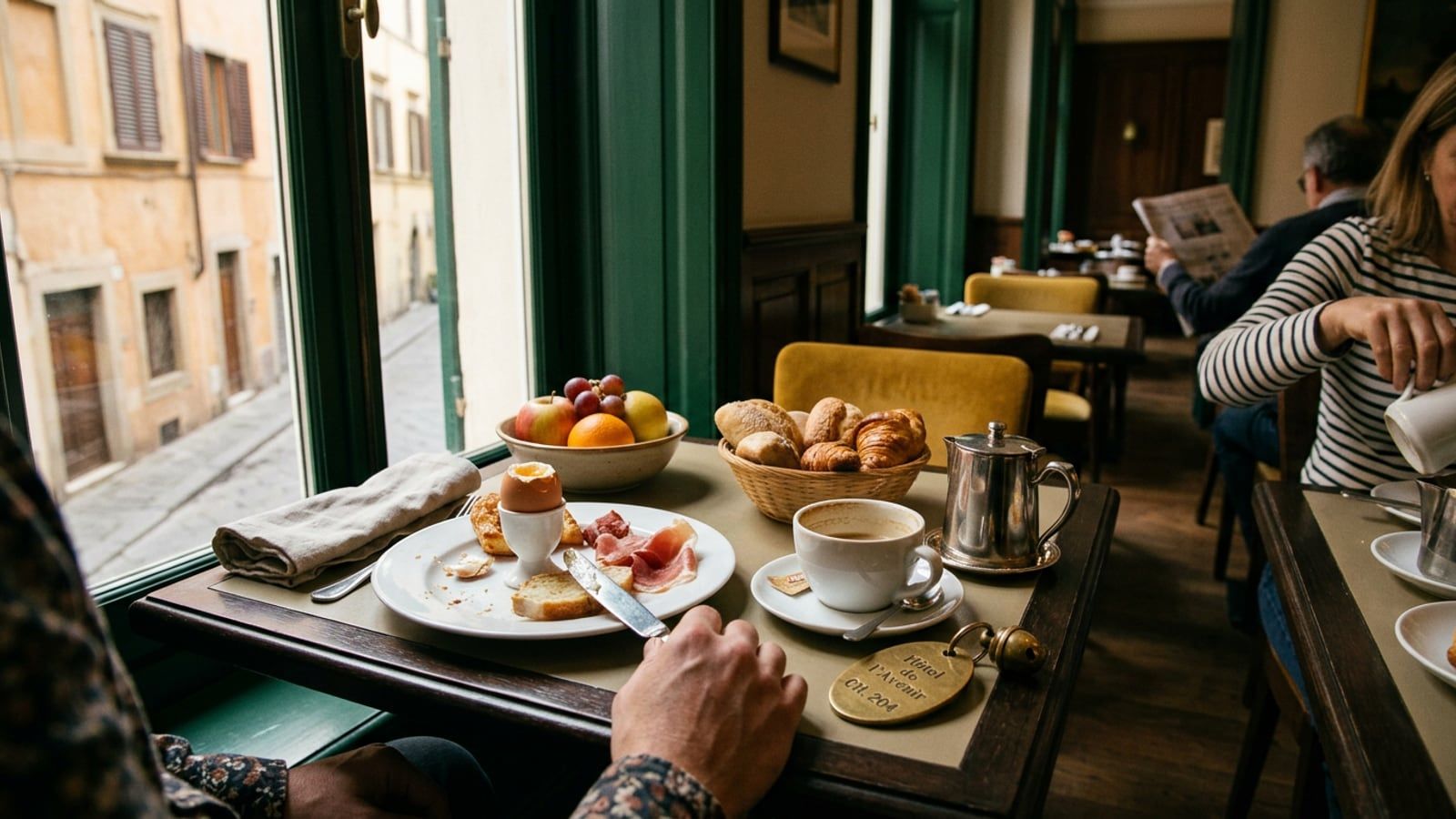
Don’t assume the hotel wins. In a city where breakfast is a coffee and a pastry standing at the counter, a hotel buffet is a bigger, slower meal than you may want with a long lunch ahead, and the bakery down the street may be the better breakfast anyway. The hotel wins when the train is early, when its breakfast is a reason to stay, or when the difference in the rate is small. If you are planning a city around its meals, City Tables puts the bed near the best of the tables, breakfast included.
City taxes, deposits and paying at the desk
The rate is not always the whole bill. Before you book either way:
- City tax. Many cities charge a tourist tax per person per night. In Lisbon, the city council charges €4 a night for guests aged 13 and over, up to seven nights in a row (€28 at most). Ask the hotel whether its quote includes it, and on a booking site read the last screen before you pay for a line saying a tax is due at the property.
- Prepayment. A pay-now rate may be charged or pre-authorised when you book, and Booking.com’s terms warn it may be non-refundable. Hotels’ own pay-now rates can work the same way.
- Deposits. A hotel may ask for a damage deposit or hold an amount on your card before or at check-in, whichever way you booked. Ask how much it is and when it is released.
- Paying at the desk. If the card machine offers to charge you in pounds, choose the local currency instead; our guide to paying in local currency or pounds abroad explains why.
Book the room after the meal that matters most, not before it. Our guide to choosing a weekend-break city for the food sets the order: the hardest table first, then the train or flight, then a hotel within walking distance of dinner.
Questions
Do hotels give a better price if you book direct?
Some do and some don’t. When Which? priced 30 stays across ten hotels and nine websites, booking direct was cheapest half the time. In the EU, Booking.com has not been allowed to stop hotels offering better prices on their own websites since 14 November 2024, so it is worth checking every time.
Can you ask a hotel to match a booking site’s price?
Yes, you can ask, though the hotel doesn’t have to agree. Email it with the room, the dates, the cancellation terms and the total you found elsewhere, and ask whether it can do better or include breakfast. If it can’t, you have lost nothing and can still book the cheaper route.
Is it safer to book through a booking site or with the hotel?
Either way your booking is a contract with the hotel; Booking.com’s own terms say it is not a party to it. What matters more is where you pay: the hotel’s official website or the booking site’s own checkout. If a message asks for card details or a bank transfer that isn’t in your booking confirmation, check it with the hotel or the booking site using the contact details on their own website.
Is breakfast cheaper if you book it with the room?
Sometimes. Take the difference between the room-only rate and the rate with breakfast, divide it by the number of guests and nights, and compare that with the hotel’s price on the day and with a café nearby. In a city where breakfast is a coffee and a pastry at the counter, price the café first.
Sources
- Which? warns holidaymakers booking independently to go direct for flights and hotels, Which?,
- Booking must comply with all relevant obligations under the Digital Markets Act, European Commission,
- Booking.com Terms of Service, Booking.com,
- Hotel booking sites to make major changes after CMA probe, Competition and Markets Authority,
- Municipal tourist tax: overnight stays, Câmara Municipal de Lisboa