 Gear
Cabin bag sizes: how to choose a carry-on that fits
Choose the allowance first, then the bag: how to measure a case with its wheels, why its own weight counts, and six airlines’ cabin bag sizes, dated.
The short versionDecide first whether you are buying for the free under-seat bag or the overhead bag, then measure the bag packed, wheels and handles included, against the smallest allowance you fly. A 40 x 30 x 15 cm under-seat bag and a 55 x 40 x 20 cm case fit all six airlines in our table, though four of them charge for the case on their cheapest fares.
Decide first which allowance you are buying for: the free bag that goes under the seat, or the bigger bag that goes in the overhead locker. Then measure the bag packed, with its wheels and handles, against the smallest allowance among the airlines you fly, and check how much of the weight limit the empty bag uses up. On the six airlines in our table, a 40 x 30 x 15 cm bag goes free under the seat on every one, and a 55 x 40 x 20 cm case fits the overhead allowance on every one, though four of them charge for it on their cheapest fares.
Decide which allowance you are buying for
European airlines’ cabin allowances come in two sizes, and a fare can include one or both:
- The free under-seat bag. Every fare on the airlines in our table includes it. It goes under the seat in front of you, so it is a backpack, a tote or a laptop bag rather than a case. On the low-cost airlines it is the only bag you don’t pay for.
- The overhead bag. A small case or a larger backpack that goes in the locker. British Airways and TAP include it on their fares; easyJet, Ryanair, Wizz Air and Vueling sell it as an extra or include it in dearer fares and bundles.
Buy for the airline you fly most and the trip you take most. A weekend city break with one change of clothes can fit the under-seat bag, and on the low-cost airlines that is the cheapest way to fly. A week with something smart for a booked dinner needs the overhead bag. Either way, leave room for what you bring home from the market.
The sizes, airline by airline
These are the cabin allowances on each airline’s own baggage page, checked on 27 October 2026. They depend on the fare and they change, so check your own booking before you fly.
| Airline | Free under-seat bag | Overhead bag | Overhead bag on the cheapest fare |
|---|---|---|---|
| British Airways | 40 x 30 x 15 cm | 56 x 45 x 25 cm, wheels and handles included; you must lift it into the locker yourself | Included |
| easyJet | 45 x 36 x 20 cm, wheels and handles included; up to 15 kg | 56 x 45 x 25 cm, wheels and handles included; up to 15 kg | Paid extra, or with some fares and seats |
| Ryanair | 40 x 30 x 20 cm | 55 x 40 x 20 cm, 10 kg | With Priority & 2 Cabin Bags |
| Wizz Air | 40 x 30 x 20 cm, 10 kg | 55 x 40 x 23 cm, 10 kg | With WIZZ Priority |
| Vueling | 40 x 30 x 20 cm | 55 x 40 x 20 cm, 10 kg | Added to a Fly Light fare, with some seats, or in the bundles that include it |
| TAP Air Portugal | 40 x 30 x 15 cm, 2 kg | 55 x 40 x 25 cm, 10 kg | Included (one item in Economy) |
Where no weight is shown, check the airline’s own page for one. TAP says that on full flights some cabin bags may go in the hold free of charge, even within the limits. If your airline isn’t here, its own baggage page has the same three things to find: the size, the weight and which fares include the bag.
Two things stand out. Under the seat, depth is the trap: 20 cm on four airlines, 15 cm on British Airways and TAP. On those two, a 20 cm deep backpack can still fly free, but as the overhead bag rather than under the seat. And the tightest overhead limits are Ryanair’s and Vueling’s 55 x 40 x 20 cm, so a case that fits those fits all six.
Measure it the way the gate will
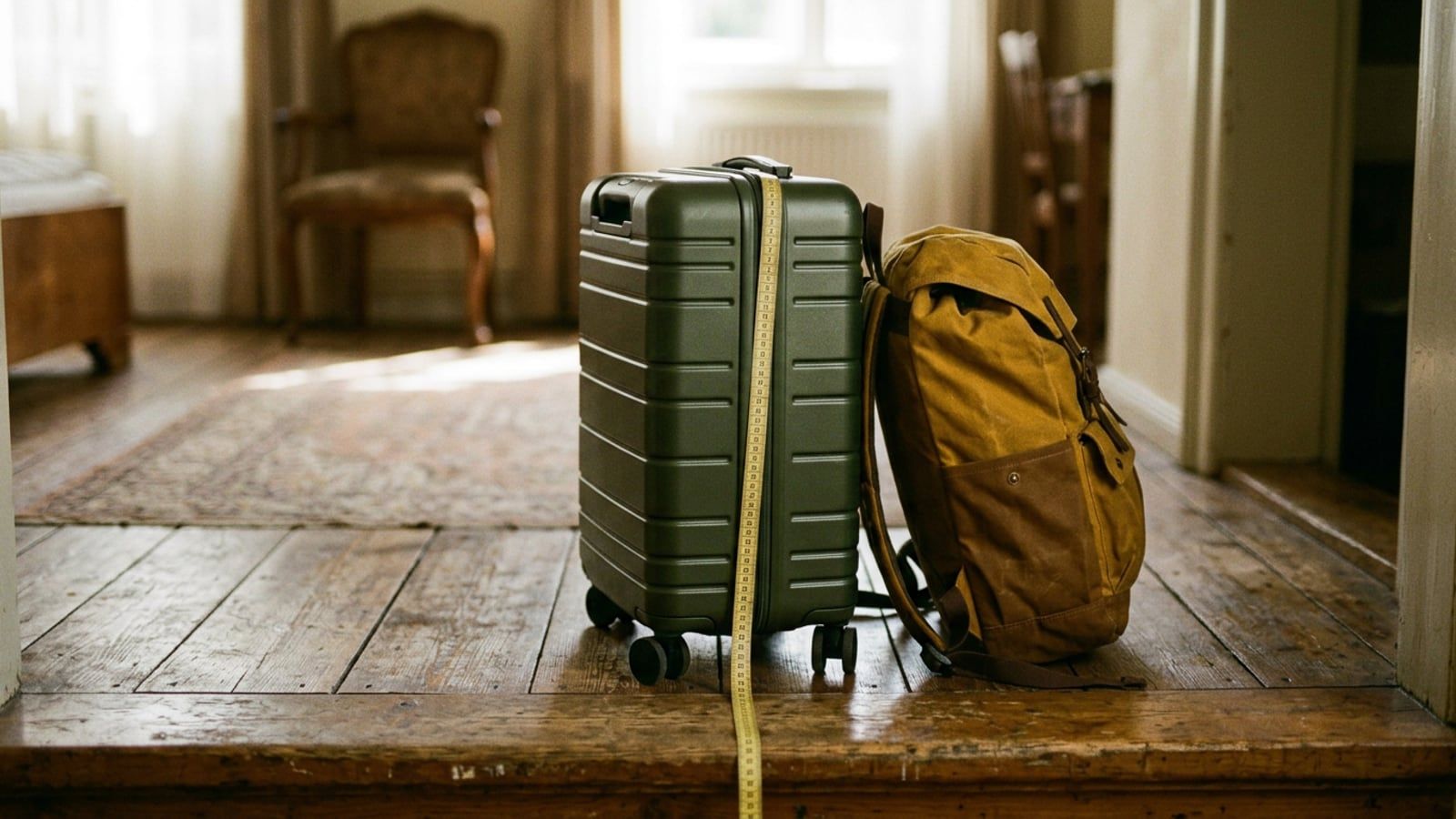
A maker’s listed size is a starting point, not a promise. Antler’s product page, for example, gives its Icon Stripe cabin case as 55 x 40 x 20 cm without saying whether that includes the wheels. Measure it yourself:
- Pack the bag as you will travel with it.
- Stand it on the floor on its wheels, with the handle pushed right down.
- Measure the height from the floor to the highest point, which is usually the top of the handle.
- Measure the width at the widest point, side handle included.
- Measure the depth from the back of the wheels to the front of the fullest pocket.
- Compare all three with the smallest allowance you fly, not the largest.
Tip: Measure a soft bag full, not empty. A backpack that measures 20 cm deep on the shelf is deeper with a jumper in the front pocket, and the sizer at the gate measures the bag you bring.
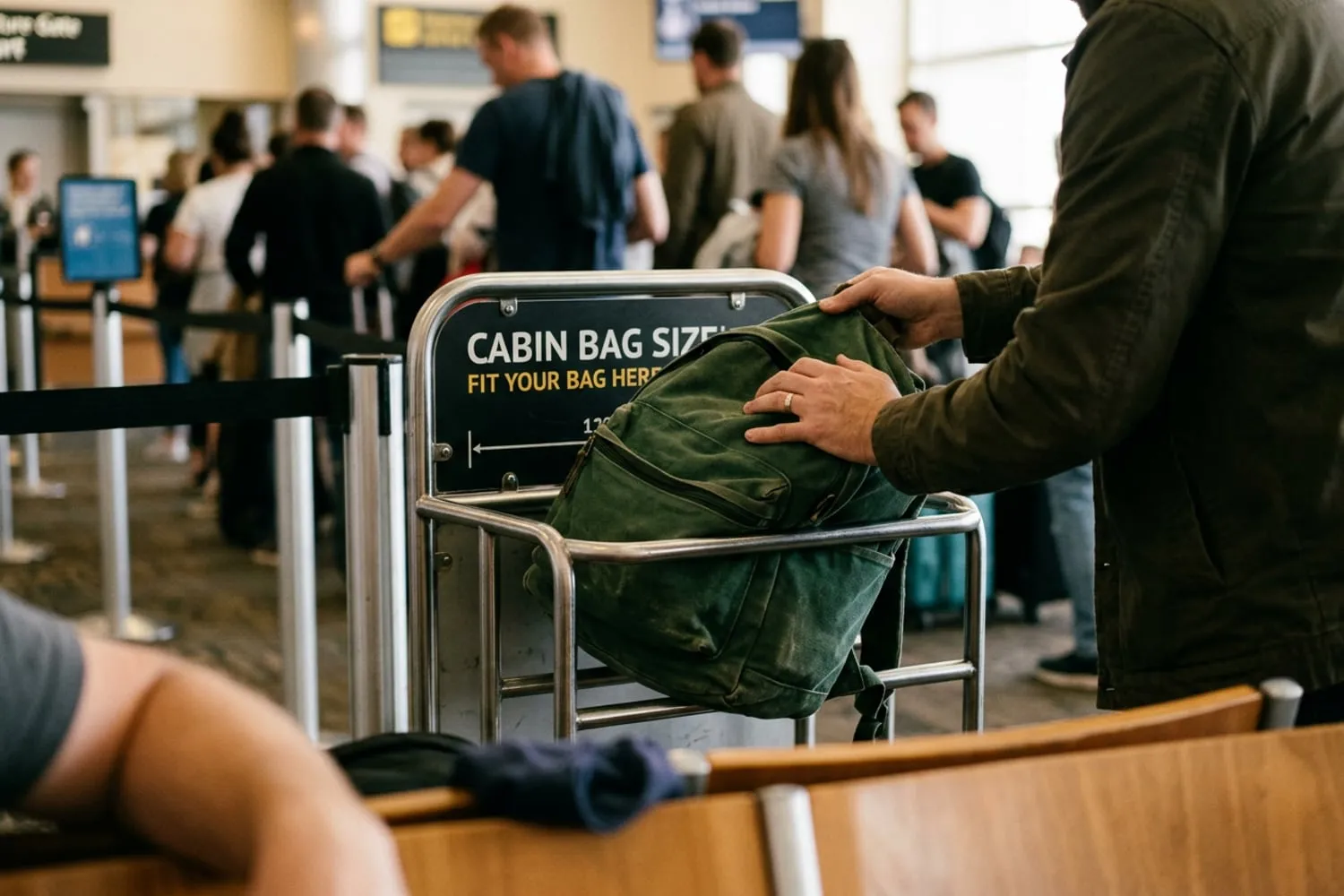
easyJet’s page says it checks cabin bag sizes before you board. A bag that doesn’t fit goes in the hold, and you pay for it there. On the day we checked, easyJet charged £60 at the gate for a large cabin bag that hadn’t been booked, and said adding one online is always cheaper. Other airlines list their gate fees on their own fees pages; look before you fly, not at the gate.
Weight: the bag’s own and the allowance
The bag’s own weight comes out of the allowance. A 10 kg limit with a 2.7 kg case leaves 7.3 kg for what you pack; with a 1.5 kg backpack it leaves 8.5 kg.
- Check the limit for your bag. On the overhead bag it is 10 kg on Ryanair, Wizz Air, Vueling and TAP, and 15 kg on easyJet. British Airways asks that you can lift the bag into the locker yourself; check its page for the weight.
- Watch the small limits. TAP’s under-seat item is limited to 2 kg, and a laptop in its bag can come close to that on its own.
- Weigh it at home. Stand on the bathroom scales holding the packed bag, then without it, and take the difference.
Two things don’t depend on the bag. Power banks travel in the cabin, never in the hold, and the UK Civil Aviation Authority says you can’t fly with more than two power banks per person and must never recharge them on board. Wine, olive oil and anything else liquid that you buy in town fall under the airport’s liquids rules in a cabin bag, so check them before you shop.
Wheels or a backpack
Wheels are easier through airports and stations, along flat pavements and on the walk from the metro to a hotel on level ground. Your back and shoulders carry nothing, and a case stands up on its own while you queue for coffee.
A backpack is easier wherever the ground isn’t flat: stairs at a station without lifts, cobbles, a hill city like Lisbon, where the old quarters climb in steps, or a hotel up three floors with no lift. Your hands stay free for a map, a ticket or a pastry. The cost is a hot back on a warm day, and the full weight on your shoulders.
Think about the last 500 metres, from the station or the bus stop to the hotel door. If it is steps and cobbles, carry the bag. If it is a flat street, wheel it.
Hard shell or soft
- A hard shell protects what is inside, keeps its shape so its size doesn’t grow when you overpack it, and opens in two halves, so packing is quick. It scuffs, and it won’t squeeze into a sizer that is a centimetre too small.
- A soft bag gives a little when the sizer is tight or the locker is full, and it has outside pockets for the passport and the book. It also grows when you overfill it, and it protects less.
For a weekend on a low-cost airline, a soft under-seat backpack is the cheap way to fly. For longer trips, or anything breakable in the case, a hard shell earns its weight.
The Kit’s bags, by type
These are the four bags on our Kit page, with the figures from their makers’ own pages, checked on 27 October 2026. The cheaper bag comes first where it does the same job.
| Bag | Type | Size | Own weight | Capacity | Price |
|---|---|---|---|---|---|
| Cabin Max Metz 24L | Under-seat backpack | 40 x 30 x 20 cm | 0.6 kg | 24 litres | £35 |
| Sea to Summit Ultra-Sil Day Pack | Packable daypack | 28 x 20 x 48 cm | 72 g | 20 litres | £32 |
| Antler Icon Stripe Cabin Suitcase | Hard-shell case, four wheels | 55 x 40 x 20 cm | 2.7 kg | 38.4 litres | £185 |
| Thule Aion Travel Backpack 40L | Soft travel backpack | 52 x 33 x 23 cm | 1.5 kg | 40 litres | £189.99 |
- The under-seat backpack. Cabin Max lists the Metz as fitting the free under-seat allowance on Ryanair, Wizz Air and Vueling, among others. It is 20 cm deep, so on British Airways and TAP it goes as the overhead bag instead.
- The daypack. The Ultra-Sil isn’t a cabin bag in its own right: it folds down small inside the case, then carries the day’s things, or the market shopping, once the case is at the hotel.
- The hard-shell case. The Antler’s 55 x 40 x 20 cm matches the tightest overhead limits in the table, but Antler doesn’t say whether that includes the wheels, so measure it. It uses 2.7 kg of a 10 kg allowance.
- The soft travel backpack. Thule calls the Aion compliant with most airlines’ carry-on requirements. At 23 cm deep it fits British Airways, easyJet, Wizz Air and TAP on paper, but is over Ryanair’s and Vueling’s 20 cm.
Still choosing where to go? Our guide to choosing a weekend-break city for the food starts with the meal, and a weekend fits in an under-seat bag. More luggage, packing and travel tech is in the Gear section, and once the bag is packed, City Tables plans the city meal by meal.
Questions
What is the standard cabin bag size in the UK?
There isn’t one standard. On the six airlines in our table, the overhead bag runs from 55 x 40 x 20 cm to 56 x 45 x 25 cm, and the free under-seat bag from 40 x 30 x 15 cm to 45 x 36 x 20 cm. A case of 55 x 40 x 20 cm with its wheels and handles, and an under-seat bag of 40 x 30 x 15 cm, fit all six.
Do wheels and handles count in cabin bag measurements?
On easyJet, yes: its sizes include any handles and wheels, and British Airways gives its cabin bag size with them included too. Not every airline says, so measure with them in, because that is the bag that has to fit the sizer.
Can I take a backpack as my cabin bag?
Yes, as long as it is within the size and weight for the allowance you are using. easyJet, for one, lists a rucksack among the bags that can be its free under-seat item, and a larger travel backpack can go as the overhead bag. Measure it packed, since a soft bag grows as you fill it.
What happens if my cabin bag is too big at the gate?
It goes in the hold, and you pay. easyJet says adding a large cabin bag online is always cheaper than at the gate, where it charged £60 on the day we checked. Other airlines publish their gate fees on their own fees pages, so check yours before you fly, and book the bag in advance if you will need it.
Sources
- Your baggage essentials, British Airways
- Cabin bag and hold luggage, easyJet
- Cabin baggage, Wizz Air
- UK’s aviation regulator advises passengers how to avoid summer flight delays caused by lithium batteries, UK Civil Aviation Authority,