 Trip Planning
El Salvador Travel Guide: Regions, Costs, Safety and Entry
El Salvador travel planning gets easier with regional stops, safety and entry tips, plus where to eat lunch, what to order, and when kitchens open.

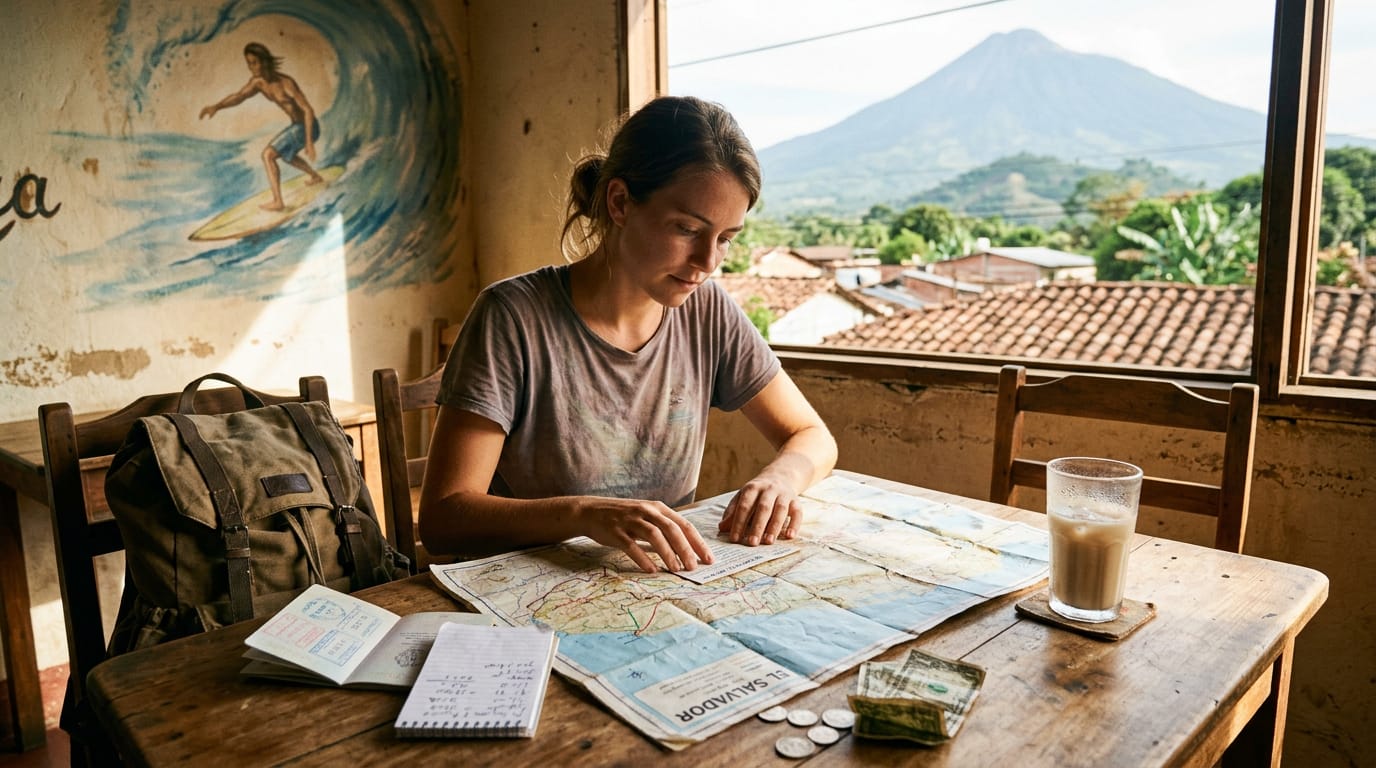
The short versionEl Salvador travel means planning a visit to a compact country of volcanoes, surf beaches, colonial towns, coffee regions, and ancient sites. Choose a few regions that match your pace, then plan around seasonal conditions, guided hikes, transport times, safety advice, entry requirements, and the meals and stays that suit your budget. Getting those practical details in place makes it easier to enjoy the variety without rushing from stop to stop.
Planning a trip to a new country is a lot like hosting a dinner party: you need to know what’s on the table, when things actually start, and who’s bringing what. The details that trip people up are often the small ones.
This guide covers El Salvador travel from start to finish: the best regions, what to do, when to go, staying safe, entry rules, costs, getting around, and where to sleep.
We also plan it around your meals, so you’ll know where to eat lunch, which dish to order, and when the kitchen opens.
Best Regions for El Salvador Travel
El Salvador packs a lot into a short trip, and each region suits a different kind of day. Choose the region first, then plan your meals around its pace.
Volcano hikes and lakeside views
Plan the Santa Ana Volcano hike for the morning, eat something light beforehand, and save a proper meal for when you’re back down. Lake Coatepeque makes an easy follow-up, with a lakeside lunch that turns a hard walk into a slow afternoon.
Conchagua Volcano offers wide views, and Cerro Verde National Park offers cooler, greener walking. Pack food for both.
Think of a couple with one clear day who wants a hike and a long lunch. Starting early and booking a lakeside table for early afternoon gives them both without rushing the walk. When you eat matters more than what you order.
Exploring the Ruta de las Flores towns
The Ruta de las Flores (the Route of the Flowers) links five colonial towns, each one worth a slow lunch. Festival dates change, so check before you go.
If a coffee or food festival lines up with your trip, eat light and let the tasting stand in for lunch.
Between towns, you can also choose:
- Ziplines for an energetic morning.
- Hot springs for an afternoon when you want to slow down.
- Waterfalls for a midday swim, with a packed picnic.
Surf towns and beaches along the Pacific
El Tunco is the livelier surf town on the coast, while El Zonte is the quieter alternative. The black sand beaches make a striking backdrop for either.
Remote coastal stays mean fewer restaurants nearby, so plan one or two meals in the place itself and stock up before you arrive.
Picture a solo traveler who wants a morning surf and calm evenings. Basing in El Zonte gives them quiet nights, with one livelier dinner out when they want it. Choose the beach for the pace you want, not the postcard.
Colonial towns and historic city centers
Suchitoto is the cultural capital, a good base for slow lunches and wandering streets. The San Salvador historic center suits a weekday lunch between sights.
If you’re basing in Santa Ana for the volcanoes, its town center is where to eat before and after each climb.
A reader with one day in the capital and an evening in Suchitoto can have a city lunch and a slow dinner in the town.
Ancient ruins and UNESCO heritage sites
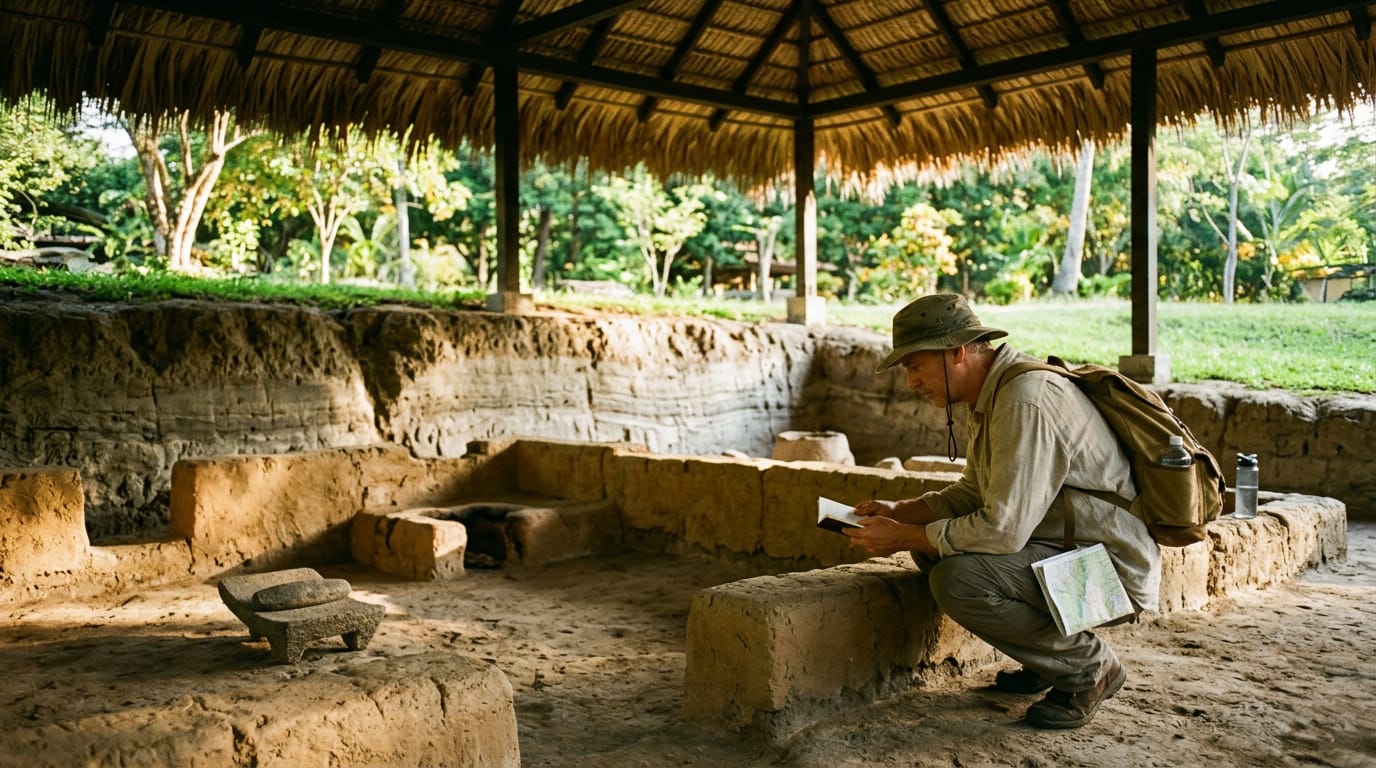
The Joya de Cerén UNESCO site is a heritage stop worth a morning, with lunch planned afterward rather than squeezed in beforehand. Tazumal Maya ruins make a similar half-day.
A history fan with one morning free can see one site, eat lunch, and still have the afternoon for a walk.
Wildlife and beaches in eastern El Salvador
The Bahía de Jiquilisco is where you go for spider monkeys, so plan that morning around a breakfast eaten before you leave. El Cuco beach is a relaxed finish, with a beachfront lunch and an easy afternoon.
Near the Gulf of Fonseca, a seafood lunch is a natural way to close the day.
What to Do on Your Trip
El Salvador packs volcanoes, waterfalls, surf, and coffee into a small country, so your days can go in very different directions. Here’s how we’d choose what fits your plans.
Get outside for hikes and watersports
Volcano hiking is the big draw, and guided volcano hikes are the easiest way in. A guide handles the route, so you can focus on the view rather than the map. Think of a couple with one free day who wants a hike and a waterfall.
They book a morning volcano hike, add a stop at Seven Waterfalls and Tamanique after lunch, and keep the evening open.
For time on the water, watersports and kayaking pair well with a slower afternoon. Some travelers go further with camping on volcano slopes, for a night closer to the trail.
Catch a wave and watch the sunset
El Salvador has world-class surf breaks, and you don’t need to be a pro to join in. Book surf lessons for your first session, and let an instructor handle the basics while you focus on balance.
Surfing is less about perfect form and more about showing up in the water.
End the day with the sunset at El Tunco. Arrive early. The sun won’t wait.
Offbeat stops, coffee tours, and markets
Off the main route, the rainbow slide at Cafe Albania is a playful stop for kids and adults alike. The hot springs waterfall offers a warm soak with water falling close by.
Picture a traveler who loves coffee. A morning coffee tour shows how the beans get from farm to cup, and an afternoon at the artisan markets lets them bring home beans and a handmade mug.
Choosing When and How Long to Go
Your dates and trip length shape everything else, so settle those two first.
Dry versus wet season, and holiday crowds
The dry season runs November through April, and the wet season runs May through October. Choose by what you want to do, not by when your calendar happens to be free.
Consider a couple who want to surf every morning. The rainy season is best for surf, so they’d plan their dates around the waves. Peak holidays bring bigger crowds, so book beds and tours early if your dates overlap one.
Multi-stop routes for one to three weeks
A one-week trip rewards a single base. Two or three weeks let you build a multi-stop route, which means sleeping in several places and moving between them.
Pick two or three regions and give each stop enough nights to justify the travel. If you add a neighboring country, treat the border crossing as its own leg, and don’t squeeze it between two busy days.
Imagine two friends with ten days: a few nights in Surf City, a sunrise climb of Santa Ana Volcano, and a market lunch. Check the transit time for each leg before you book a hotel, since a long transfer can swallow the afternoon you planned on the sand.
Booking local guides and day tours
The Ministry of the Environment is clear: hikers climbing Santa Ana Volcano must go with an authorized guide. Build your sunrise start around the guide’s schedule. Book the guide first.
If you’re based in Surf City, ask which day tours leave from there, and check each start time against your surf sessions. A tour from your base means one fewer leg to plan.
Staying Safe During Your Visit
Safety is usually the first thing people ask about El Salvador, so let’s start there. Here’s what has changed and the habits that keep a trip relaxed.
How safe the country is right now
For years, El Salvador carried a reputation for gang violence. According to the El Salvador Country Security Report, the government’s crackdown on gangs has led to a sharp decrease in violent crime.
For tourists, the guidance is clear. The U.S. Department of State travel advisory in place when that report was published asks travelers to exercise normal precautions. Normal precautions, not special ones.
Some neighborhoods carry more risk than others, so take advice to avoid specific areas seriously. Ask your hotel which streets to skip after dark.
Consider a solo diner who books a midday lunch, takes a taxi back before dusk, and asks the front desk which blocks to avoid. That keeps the trip about the food, not the logistics.
Precautions worth taking on your trip
A few habits do most of the work:
- Check the advisory. Read the U.S. Department of State advisory before you book and again before you fly.
- Think through travel insurance. Read the policy for medical care and evacuation.
- Watch your belongings. Keep phones out of sight on busy streets and leave your passport in the hotel safe.
Safety isn’t uniform across the country. It’s less about whether to go and more about where you’re headed and how you get around. Match your precautions to each stop on your itinerary. Plan ahead, then relax.
Entry Rules and Practical Details
Here are the key facts at a glance:
- Currency: US dollar
- Language: Spanish
- Time zone: GMT-6, six hours behind Greenwich Mean Time
- Power: 110V outlets
Visa rules, passport needs, and exit tax
The U.S. Embassy in El Salvador says eligible visitors can stay visa-free for up to 90 days. The entry card is valid for 90 or 180 days, depending on passport validity and purpose of travel.
It’s less about whether you get in and more about how long you stay.
El Salvador is part of the CA-4 agreement, a regional deal letting eligible travelers move among Guatemala, Honduras, El Salvador, and Nicaragua under shared immigration rules, per a guide from elsalvador.com.
Be ready to show proof of an onward ticket, the flight or bus that takes you out of the country. Plan for an exit tax on departure, and confirm the current amount before you travel.
How much is $100 US in El Salvador?
El Salvador uses the US dollar, so $100 is simply $100 here. It’s a cash-based economy, so carry small bills and use ATMs, since card acceptance varies. Bitcoin is legal tender too, but you’ll mostly spend US dollars.
Plan on a 10% service tip, and check posted menus for prices.
For example, a solo diner with a noon lunch can add up the meal, tip, and taxi to test whether $100 covers the day.
Phones, Wi-Fi, and power on the go
Buy local SIM cards from Claro or Tigo, or use an eSIM (an embedded SIM you set up digitally). Do it before you land. Don’t count on Wi-Fi for maps or bookings. Outlets run on 110V, so check your chargers.
Local time is GMT-6, so double-check reservation times. Spanish is the main language, so a few phrases help.
Getting to and Around the Country
Your first meal depends on how you arrive, so plan backward from the airport, border, or dock.
Arriving by air, land, or boat
El Salvador has a single international airport, so most visitors fly in through one gateway. Travelers arriving overland cross the land borders with Guatemala and Honduras, and some come by boat from Nicaragua.
If the coast is your first stop, sort out the transfer before you land: a taxi or a pre-booked shuttle both work.
Consider a couple flying in for a long weekend who want lunch by the water. Booking their shuttle before boarding means no haggling at arrivals and a seaside lunch on schedule.
Moving around by bus, taxi, or car
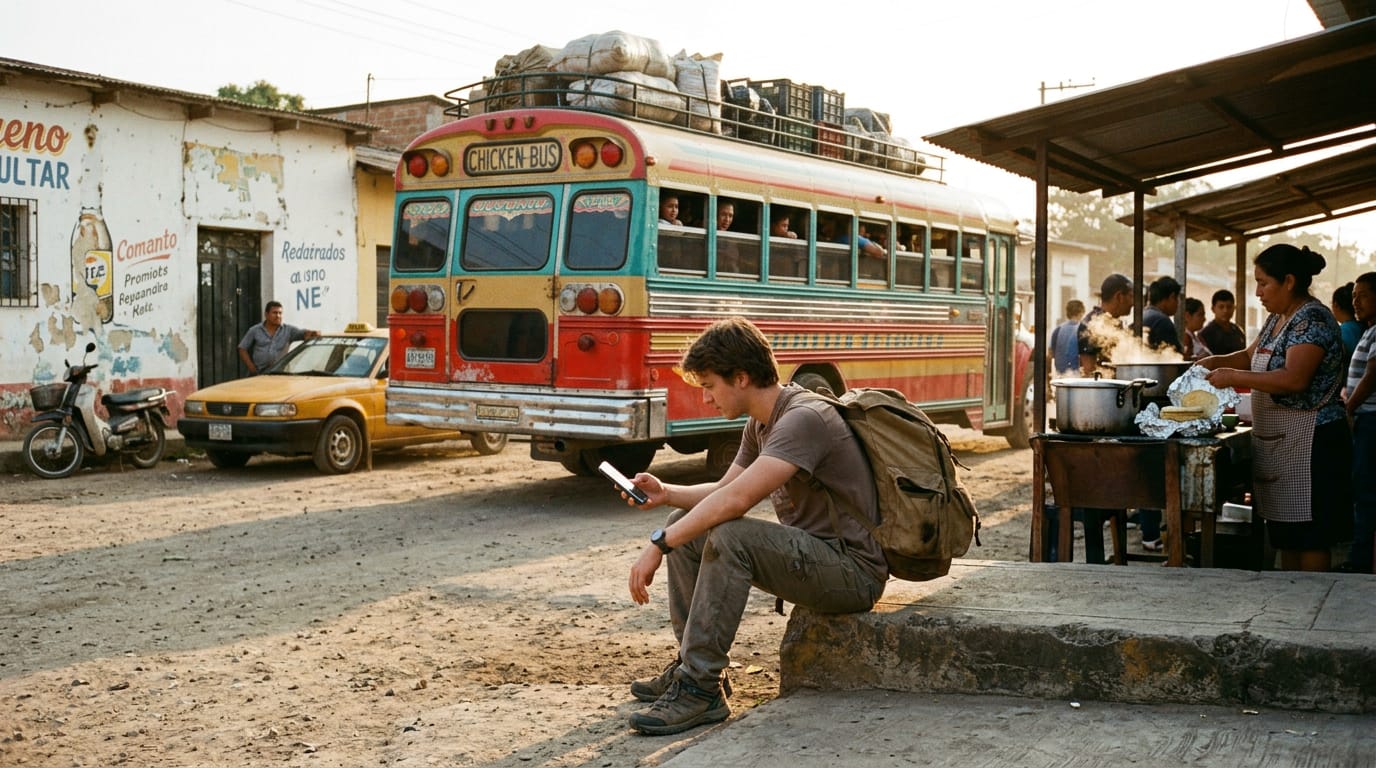
The chicken buses are the colorful local buses, and they’re a budget-friendly way to get around. Cheap isn’t the same as easy, though: they take longer than a car, so build extra time into any plan.
Uber and taxis are the simplest door-to-door option when you’re carrying bags or heading somewhere a bus doesn’t go, and they’re the smart call after a late dinner.
Rental cars give you the most freedom to stop at a market that catches your eye, while scooters suit short hops.
For a set departure, book a seat through Bookaway so your ride doesn’t depend on luck. Distances are short, so a lunch in a neighboring town makes a realistic day trip. Book the ride first, then the meal.
Where to Sleep During Your Trip
Where you sleep shapes the whole rhythm of your trip, from the early market run to the walk home after dinner. Here’s how your main options compare, and what they cost.
Hotels, hostels, and lakeside or beach stays
You have three main kinds of stay to weigh.
- Boutique hotels are small properties with a personal feel, a good fit if you want character with your comfort.
- Budget hostels keep costs low and are a friendly choice for solo travelers, though you’ll share space with others.
- Lakeside and beach stays put you close to the water, so a slow afternoon is a short walk away.
Hostels ask you to give up privacy to save money, while boutique hotels ask you to spend a little more for atmosphere.
Two names worth a look are Palo Verde and Casa 1800.
Consider a solo traveler who books a dorm bed for the busy city nights and a private room at a lakeside stay. The city nights stay cheap, and the lake gives them the quiet they wanted after a busy week.
What private rooms and dorm beds cost
A private room runs around $50-70, while a dorm bed costs $15-25. Dorm beds win on savings, while private rooms win on comfort.
El Tunco is the exception: rooms there are limited and pricey. Book early.
What to Eat and Drink There
Food is one of the simplest ways to get to know a place, and El Salvador rewards planning around its meals. Here’s what to order, what to drink, and how to fit lunch into your day.
Pupusas and other classic Salvadoran dishes
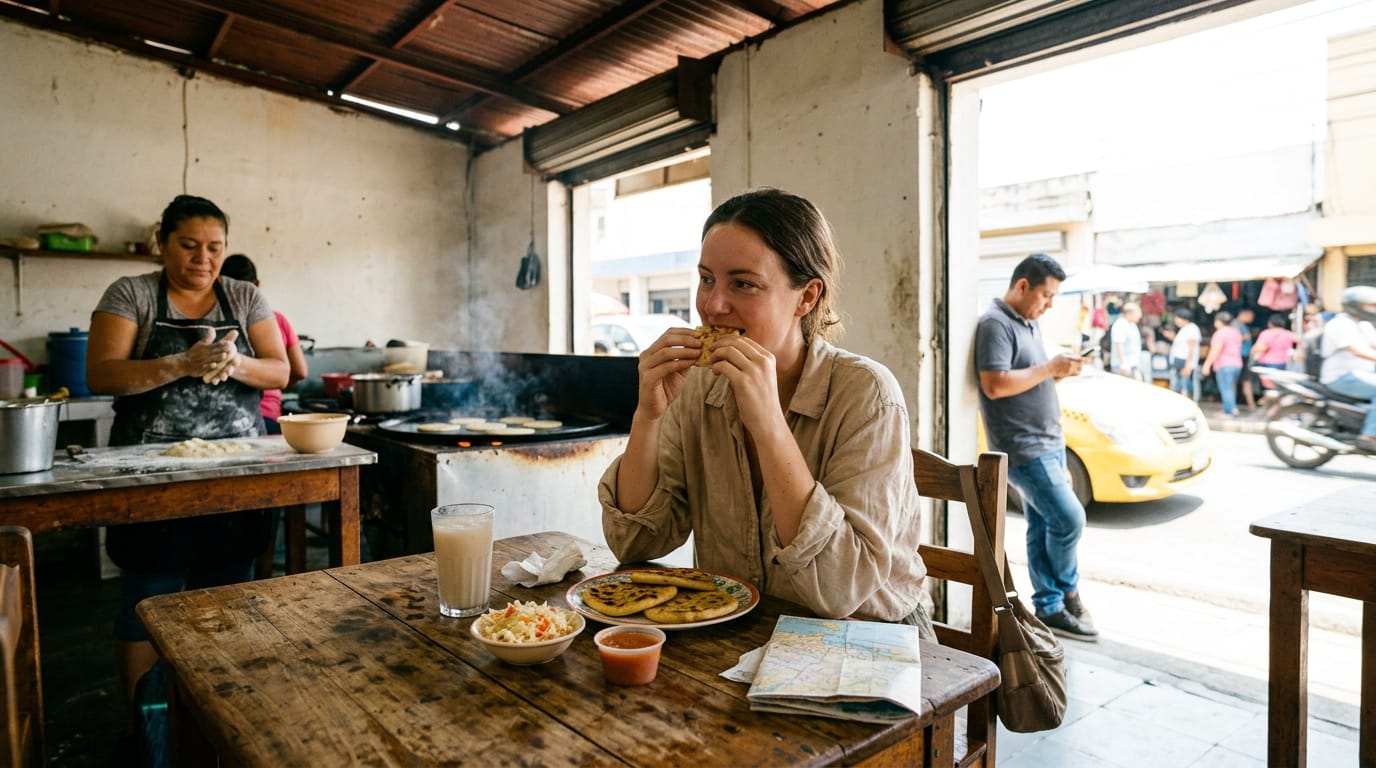
The pupusa is the national dish, so it’s the first thing to order. For a slow start, try the desayuno típico, the typical breakfast, and keep an eye out for riguas and yuca, two more classics worth trying.
Mangoes are seasonal, so eat them when they’re in season, not whenever you’re craving one. Learning to make pupusas at home keeps the meal going after you’re back: ask a local cook to show you the basics, then try them in your own kitchen.
Consider a traveler with one free afternoon between two stops who wants a proper meal without losing the day. Choosing the lunch spot on the map before leaving means it’s settled before anyone gets hungry. Plan it early.
Where to eat by region works the same way: match the stop to the area you’re in that day, so you’re not backtracking.
Beers, coffee, horchata, and coastal food
Pilsener is the everyday beer, and craft beer is there when you want something different. Coffee is a pause rather than a quick fix, so give each cup time. Horchata, a sweet, cold drink, pairs well with a midday meal.
Along the coast, international food sits alongside Salvadoran dishes, so a change from pupusas is easy to find.
El Salvador is easier to enjoy when the practical pieces are in place: a region that suits your pace, a plan for staying safe, clear entry rules, a realistic budget, and a way to get between stops without stress.
Put those together and the whole trip gets simpler.
Then let the meals set the rhythm. Book the lunch you care about, leave the evening loose, and let the market and the bakery fill in the rest.
Plan the details, then pull up a chair and eat.
References
- El Salvador Country Security Report — osac.gov (2026)
- Travel Requirements — sv.usembassy.gov
- ¿Vas a viajar a El Salvador? Revisá estos requisitos — elsalvador.com (2026)
- Amanecer desde el volcán de Santa Ana: horarios y requisitos — elsalvador.com (2026)
Questions
What are the key information about El Salvador?
El Salvador is a small Central American country whose capital is San Salvador. Spanish is the main language, the U.S. dollar is its currency, and the time zone is GMT-6. Visitors come for volcano hikes, Pacific surf beaches, colonial towns, coffee, and historic sites.
How much is $100 US in El Salvador?
El Salvador uses the U.S. dollar, so $100 USD is worth $100 there. Carry small bills because cash is widely used and card acceptance varies.
How far does $100 go in Belize?
Belize’s dollar is pegged at 2 Belize dollars to 1 U.S. dollar, so $100 USD converts to about BZ$200. How far it goes depends on your plans: local meals and buses can be affordable, while resorts, tours, and activities in popular cayes can cost considerably more.
Is it safe to travel to Belize right now?
Safety conditions can change, so check your government’s current travel advisory and local news before departure. In Belize, use particular caution in Belize City’s Southside, avoid isolated areas after dark, and arrange reputable transport and tours.
Is Belize good for Americans?
Belize can be a convenient choice for Americans: English is the official language, the U.S. dollar is widely accepted, and the country offers beaches, snorkeling, diving, and rainforest trips. Check current entry requirements, travel advisories, and transport plans before you go.
Which is safer, Belize or Costa Rica for vacation?
Neither country is uniformly safe, and risk depends on the places you visit and your precautions. Costa Rica is often considered the safer choice overall, but it has crime risks, while Belize has areas with elevated violent crime; check current advisories and avoid higher-risk neighborhoods in either country.
Sources
- El Salvador Country Security Report, osac.gov,
- ¿Vas a viajar a El Salvador? Revisá estos requisitos, elsalvador.com,
- Travel Requirements - U.S. Embassy in El Salvador, sv.usembassy.gov
- Amanecer desde el volcán de Santa Ana: horarios y requisitos, elsalvador.com,